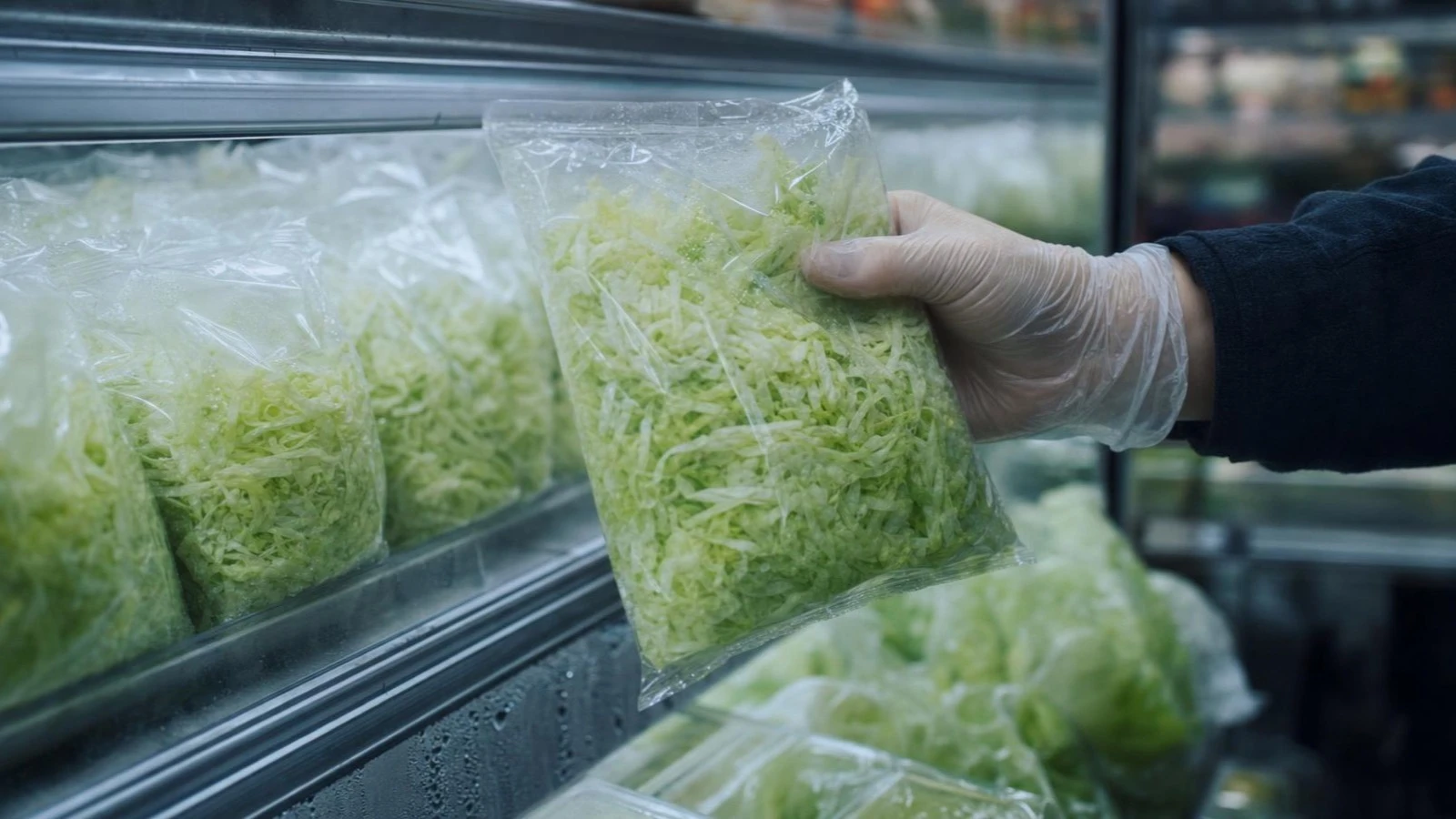
By the time anyone knew the lettuce was dangerous, most of it had already been eaten.
That's the strange truth at the center of the Taylor Farms recall. On July 17, a company reached into 27 states at once and started pulling shredded iceberg lettuce back out of Walmart coolers, Sysco warehouses, and the kitchens of thousands of restaurants. But that lettuce had shipped weeks earlier, and fresh-cut iceberg barely lasts two weeks in the bag. So the recall was chasing something that was, for the most part, already gone.
Which leaves an honest question. How do you recall food that people have already digested, and what's the point of trying? The answer is a hidden machine most of us never see, and the 2026 cyclospora outbreak switched it on in full view. Watch that machine run once and you understand every food recall.
First, someone has to notice you got sick from a salad topping
A recall doesn't start on a loading dock. It starts with a question investigators ask sick people: what did you eat?
That question mattered more than usual here, because the culprit was a parasite. Most big outbreaks get solved with DNA fingerprinting. When E. coli or Salmonella shows up, public health labs sequence the germ's genetic code and match it across states through a network called PulseNet, the way detectives match a fingerprint at two crime scenes. Cyclospora breaks that tool. It's a single-celled parasite, not a bacterium, and it can't be grown in a lab dish or easily sequenced from a stool sample. There's no clean fingerprint to pass around.
So investigators fell back on the oldest technique there is, which is talking to people. In Michigan, health officials pulled the food histories of 190 people who'd gotten sick and eaten at Taco Bell, and reconstructed their meals. Ninety percent of them had eaten iceberg lettuce. A shredded topping almost nobody thinks twice about had just become the prime suspect.
A suspect is not proof. To turn one into the other, the FDA runs a traceback. Investigators pull the invoices, shipping records, and lot codes for the lettuce at each Taco Bell where people got sick, then walk that paper trail backward, one supplier at a time. When the trails from five different states all bend toward the same door, that's what the FDA calls convergence on a single supplier. Here, every path ran back to one supplier of central-Mexico iceberg, Taylor Farms de Mexico.
Notice what did the naming. Not a test on the lettuce, but the pattern of who got sick and where their food came from. That's usually how it goes with cyclospora, a parasite that's notoriously hard to catch on produce. For a day, one sample of the supplier's iceberg looked positive, then FDA scientists re-reviewed it and called it a false positive, and as of July 19 no sample had confirmed the parasite at all. The recall didn't need one. It stood on the epidemiology and the paper trail, which is how most produce outbreaks get solved.
Here's the wrinkle worth understanding. That same supplier's lettuce was also fanning out to grocery shelves and other kitchens under different labels, so a shared item on one menu couldn't name the source by itself. Taco Bell was the brightest thread running through the interviews. It still took the paper trail, not the storefront, to trace the blame back to one supplier.
The surprising part is that the FDA usually can't make anyone do this
A recall sounds like something the government orders. It almost never is.
By the FDA's own account, food recalls are "almost always voluntary." The company finds the problem, or gets shown it, and pulls the product itself. For most of American history the FDA couldn't even force a food recall. It could ask, it could publicize, it could go to court to seize the product, but it couldn't simply order a company to clear the shelf. That changed only in 2011, when the Food Safety Modernization Act finally gave the agency authority to order one. In the years since, the FDA has used that hammer only a handful of times. The threat is what does the work. It makes the polite request very hard to refuse, so the recall almost always happens "voluntarily" before it ever comes to an order.
That's exactly what happened here. Taylor Fresh Foods, the U.S. company that does business as Taylor Farms, voluntarily pulled all iceberg lettuce sourced from central Mexico. One naming detail matters, because the recall turns on it. The supplier the FDA named sits in Mexico, Taylor Farms de Mexico. The company that issued the recall is its U.S. affiliate, Taylor Fresh Foods. Keep the two straight and the rest of the story stays clear.
Not every product pulled off a shelf is a recall
The word itself carries weight, and three of them look identical on a loading dock while meaning very different things in law.
A recall means the product actually breaks a law the FDA could act on, and it lands in the agency's public enforcement record. A market withdrawal is a smaller matter, a minor issue or none at all, closer to housekeeping. A stock recovery is product a company catches before it ever leaves its own control. Which word a company gets to use is itself a decision with consequences.
There's a severity rating hiding in the system too. The FDA sorts recalls into three tiers by how much harm the product could do. Class I is the most serious, used when the food could cause serious injury or death. Class II covers temporary or reversible effects, and Class III covers products unlikely to hurt anyone. And here's the counterintuitive part. That grade usually gets assigned after a recall is announced, not before. The company pulls the product first, and the government rates the danger later, once it reviews the details, which is why a recall can dominate the news for days with no class attached to it yet.
So how do you pull lettuce out of 27 states at once?
You start with a code, because a modern recall is a feat of identification before it's a feat of retrieval.
Read Taylor Farms' recall list and you hit a wall of cryptic tags, MKTSD, JB, SY, TF, each one paired with a pack size and a "best if used by" date. They're customer codes, not random. MKTSD is Marketside, the Walmart store brand. The rest mark the restaurants and foodservice distributors that received the same lettuce, buyers reporting soon matched to household names, from Jack in the Box to Sysco, the largest foodservice distributor in the country. Tying it all together is the humble best-by date. There's no barcode that says "contaminated." Instead a date like 7/18 to 8/3 is welded to a specific production run, so the recall can pull those exact bags and leave every other head of lettuce in the country alone. It's forensic identification by expiration date.
Then the message has to travel. Under federal recall rules, the recalling company notifies its direct customers, who notify theirs, and the warning ripples outward. In real time it moved fast and visibly. Sysco stopped shipping the Mexican iceberg and told its restaurant customers to destroy what they already had. Walmart pulled its Marketside bagged salads from shelves. Jack in the Box swapped in lettuce from a different supplier. Taco Bell stopped using the Taylor Farms de Mexico lettuce across its entire national supply chain, not only in the five outbreak states.
At each stop, real hands do the work. In a grocery store, the recall triggers a scan-block at the registers, so if a recalled bag reaches the checkout belt, the system simply refuses to sell it. Night crews run shelf sweeps, receivers stop trucks that were already rolling when the recall hit, and the pulled product goes into a quarantined hold it can't escape. In a restaurant it's even more direct. A line cook reaches into the prep station and throws the lettuce away. One notice, thousands of walk-in coolers. And the FDA doesn't just take the company's word that all this happened. It monitors what the agency calls effectiveness checks, auditing down the chain to confirm each distributor, store, and restaurant actually got the notice and actually pulled the product. What gets caught this way can't be cleaned and resold. A contaminated leafy green is quarantined and destroyed, sometimes with the FDA watching the disposal.
One line has to stay bright through all of this. Walmart, Jack in the Box, and Sysco are on the distribution map, not the list of people who got sick. The confirmed illnesses in this outbreak trace to Taco Bell. On the day the recall issued, the CDC said the shredded iceberg sold under the Marketside label in grocery stores wasn't tied to the illnesses. Those retail bags were pulled as a precaution, which is the whole idea of a recall, to move before the harm rather than after it.
The recall is chasing a ghost
Now back to the paradox we opened with, because it's the thing almost nobody tells you about fresh food.
The recalled lettuce shipped between June 29 and July 16. The recall went public on July 17 and 18. Fresh-cut iceberg lasts roughly two weeks in a sealed bag and only a few days once you open it. Do that math and most of the product was eaten, tossed, or turned to slime in a refrigerator drawer before anyone said the word recall. Food scientists say this plainly in their own studies. With leafy greens, they write, "harvest and distribution have been completed before the implicated ranch can be identified." By the time the trail reaches the field, the crop is already on dinner plates.
It gets more maddening. There's a law written for exactly this nightmare, and it wasn't switched on yet. The FDA's Food Traceability Rule, part of the Food Safety Modernization Act, forces high-risk foods like leafy greens to carry a standardized paper trail through every step of the supply chain, so investigators can map a chain in a day instead of a month. A peer-reviewed study of romaine outbreaks showed the gap in black and white. With good lot codes, the entire supply chain was traced in 24 hours or less. Without them, it took 5 to 25 days, longer than the lettuce's own lifespan. The catch is that the rule doesn't become enforceable until July 2028, so the 2026 traceback still ran on the old patchwork of phone calls, emails, and mismatched spreadsheets.
And none of it showed on the plate. Cyclospora can't be rinsed off, and contaminated lettuce doesn't necessarily look or smell wrong. The greens can stay crisp and fresh while carrying a parasite that will make someone sick a week later. If you want to understand why a topping this ordinary caused this much trouble, our explainer on what cyclospora actually is walks through why a quick rinse can't wash the worry away.
So what's a recall even for?
If the food is already gone, a recall still does two things that matter, and they're the reason it's worth all the trouble.
First, it slams the door on whatever's still in the system, the cases sitting in a Sysco warehouse, the bags in a back room, the tub of shredded lettuce in a restaurant walk-in. That's the part a recall can physically claw back, and stopping it keeps the next person from getting sick.
Second, and more important for a food this perishable, it fires a flare into the sky. A recall tells everyone who ate that lettuce weeks ago to watch for symptoms and, just as important, to tell a doctor what they ate. Cyclospora isn't the kind of stomach bug that clears on its own in a day. It can drag on for weeks and often needs a specific antibiotic, and a standard stool test won't even catch it unless a doctor asks. The public warning is what stitches a scattered wave of sick people into a single cause, and what points them toward the right treatment. For a food this perishable, a recall is mostly information and only a little retrieval.
What to do if the lettuce reached you
If you've got a recalled Marketside bag from Walmart in your fridge, the instruction is simple. Don't eat it. Throw it out or take it back for a refund, and wash anything it touched.
If you ate shredded iceberg at a Taco Bell in Indiana, Kentucky, Michigan, Ohio, or West Virginia this summer and then came down with the watery, exhausting, weeks-long illness cyclospora causes, the more useful step is to tell your doctor what you ate and ask specifically about cyclospora, since a routine test can miss it. A confirmed diagnosis and a note of where you ate are the details that matter most later.
They matter legally too. Ron Simon & Associates has already filed suit on behalf of a victim in this outbreak, and the firm is looking into claims for others who were sickened by the lettuce served at Taco Bell. If that includes you or your family, you can talk with our cyclospora outbreak team about what happened and whether you have a case. The consultation is free, and you pay nothing unless we recover money for you.
A recall is the food-safety system reacting in public, at speed, to protect the people who haven't gotten sick yet. It isn't a remedy for the people who already have. That part's a separate process, and it's the one we handle.
Frequently asked questions
What happens if I ate recalled food?
Usually nothing, especially if you feel fine. A recall is a precaution aimed at everyone who might still have the product, not a verdict that you're now sick. Watch for symptoms tied to the specific hazard, keep the packaging or your receipt if you can, and call your doctor if you feel ill. With cyclospora, symptoms usually start about a week after exposure, so a recall can land before you'd notice anything at all.
Is a recall the same as a market withdrawal?
No. A recall means the product violates a law the FDA could act on, and it goes into the agency's public enforcement record. A market withdrawal covers a minor issue with no legal violation, closer to routine cleanup, and it isn't listed the same way. A third term, stock recovery, refers to product a company pulls back before it ever leaves its own control. The words look interchangeable and carry very different legal weight.
What is a Class I recall?
A Class I recall is the most serious tier. The FDA uses it when there's a reasonable probability the product will cause serious harm or death. Class II covers temporary or reversible health effects, and Class III covers products unlikely to hurt anyone. The FDA, not the company, assigns the class, and it usually does so after the recall is already underway.
Who orders a food recall, the government or the company?
Almost always the company. The FDA says food recalls are "almost always voluntary." The agency only gained the power to force a food recall in 2011, and it has used that authority rarely. In practice the company announces the recall itself, under close government supervision and the standing threat that the FDA could step in.
How do stores remove recalled food from shelves?
They pull it fast, then block it from coming back. As soon as a recall hits, staff clear the affected product from shelves, and the registers get a scan-block so a recalled item can't be sold even if it reaches the checkout. Night crews run shelf sweeps, receivers stop shipments that were already in transit, and the pulled product goes into a marked hold area. Restaurants and distributors get the same notice and pull the product from their kitchens and warehouses.
How do I check whether my food is part of a recall?
Match the specifics, not just the brand. Recalls are tied to exact products, package sizes, and "best by" or lot codes, so a bag on your counter is only affected if its details match the notice. The FDA posts recall notices on its website, and the recalling company usually lists the exact products, codes, and dates. If a restaurant is involved and you're not sure of the source, you can ask the restaurant directly.
Why do food recalls take so long?
Because the science takes time and the food doesn't wait. It can take weeks to spot an outbreak, interview enough sick people to find the common food, and trace it back to one supplier, and a parasite like cyclospora is especially slow to pin down. Fresh produce crosses the country in days, so it's often eaten long before the investigation catches up. The delay usually isn't negligence. It's the gap between how fast food travels and how long it takes to prove what went wrong.
---
This article is general information about how food recalls work and about a specific 2026 outbreak. It isn't legal or medical advice. If you think a recalled food made you sick, contact your doctor. Results vary by case. Consultations with our firm are free, and you pay nothing unless we recover money for you.