
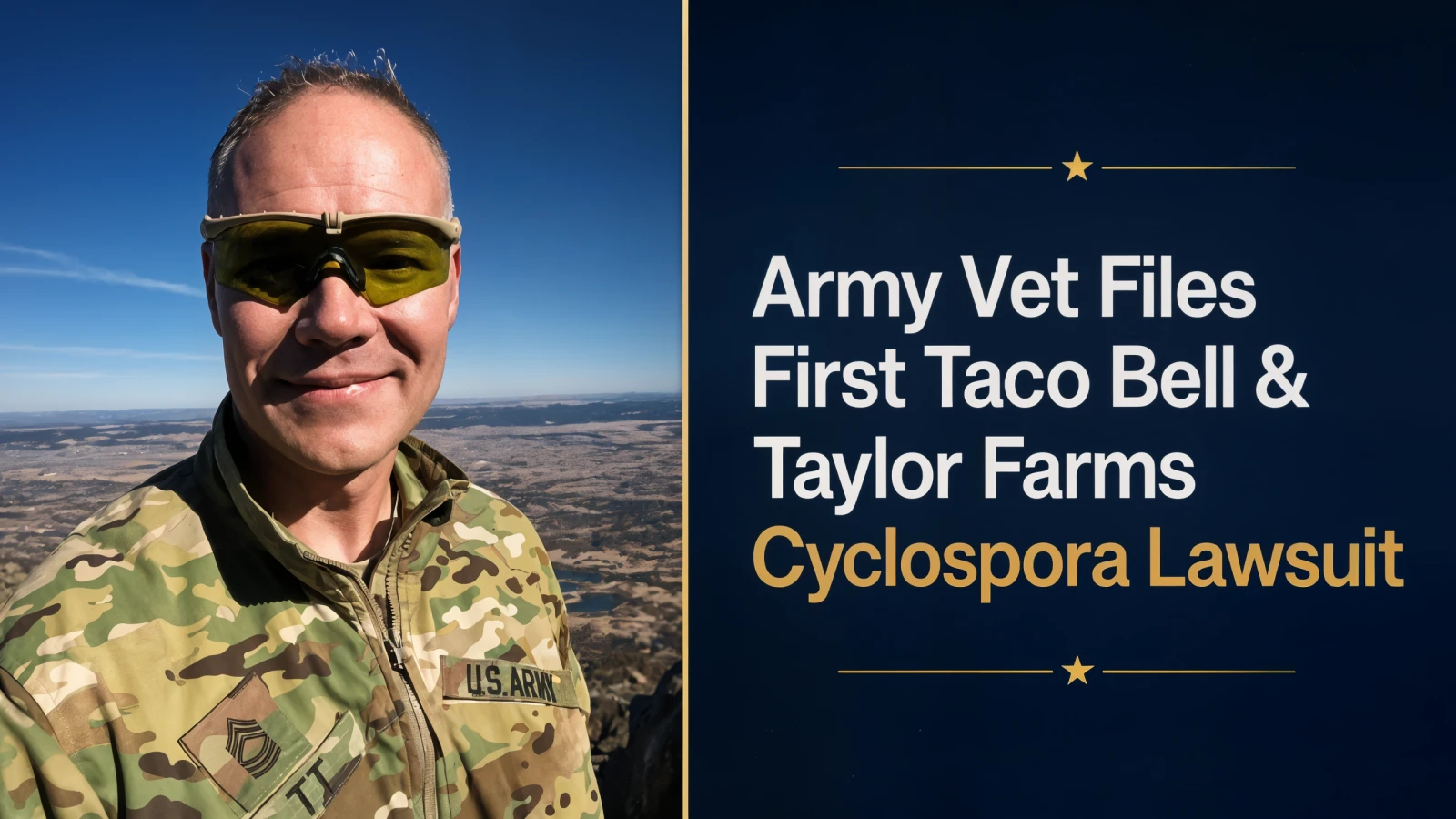
A 27-year veteran of the U.S. Army spent two days in a hospital bed this summer, in excruciating pain from a stomach illness that kept getting worse, before a lab finally figured out what was wrong. It turned out to be Cyclospora, a microscopic parasite, and investigators have tied it to the shredded iceberg lettuce served at the fast-food chain he trusted.
On July 17, 2026, that veteran, David Ott, filed suit against Taco Bell and Taylor Farms, the company his lawsuit names as the chain's iceberg lettuce supplier. Ron Simon & Associates, working with the firm DiCello Levitt, brought the case in Mahoning County, Ohio. It's the first lawsuit in the nation against Taco Bell and Taylor Farms over this outbreak, and the firm already represents hundreds of people sickened in what has become one of the largest cyclospora outbreaks in recent U.S. history.
If you ate at Taco Bell this summer and then couldn't shake weeks of watery diarrhea, this is the case you've been reading about, and you may be wondering whether you can file a Taco Bell Cyclospora claim of your own.
Why are Taco Bell and Taylor Farms being sued?
Because a restaurant and the companies that supply its food can be held responsible when contaminated food makes a customer sick, and Ron Simon & Associates alleges that's exactly what happened to David Ott. The lawsuit names three defendants, each for a different role in getting that lettuce onto his tray:
- Taco Bell Corp., the national chain that sold the food.
- Charter Foods, Inc., the franchisee that operates the specific Taco Bell in Youngstown, Ohio where he ate.
- Taylor Fresh Foods, Inc., doing business as Taylor Farms, the company behind the recalled iceberg lettuce.
The firm alleges that the food Mr. Ott bought was defective and unreasonably dangerous because it carried Cyclospora, that the companies failed to keep the parasite out of their supply chain, and that they didn't warn customers about the risk. The complaint brings claims for product liability, negligence, and breach of the implied warranty that food sold to the public is fit to eat. It asks for compensation for his medical bills, lost wages, and the physical toll of the illness, along with punitive damages.
"David Ott gave twenty-seven years of his life to this country. He should not have had to spend his summer vacation in a hospital bed because a lettuce supplier and a national restaurant chain failed to keep a parasite out of the food they sold him," said food safety attorney Ron Simon. "Cyclospora does not appear in food by accident. It gets there when produce is grown, washed, or handled in contact with human or animal feces. In this litigation, we will make sure that all of our clients are fully and fairly compensated, we will find out exactly how the lettuce became contaminated, and we will make sure that Taco Bell and Taylor Farms take the steps necessary to ensure that this never happens again."
Who is David Ott?
David Ott is a 27-year Army veteran who, like a lot of people, counted Taco Bell as one of his regular stops. In mid-June he bought Taco Supremes at a Taco Bell in Youngstown, Ohio, on June 18 and again on June 20. By the morning of June 22, he was in serious trouble: excruciating abdominal pain, relentless diarrhea, bloating, nausea, dizziness, and a low-grade fever.
When it kept getting worse, his wife Kendle rushed him to the hospital. Doctors admitted him and ran him through a colonoscopy, a CT scan, and round after round of blood and stool work. Most of it came back unremarkable, and the staff was stumped, until someone thought to test specifically for Cyclospora. That test came back positive. He was discharged after two days with a prescription for Bactrim, the antibiotic that treats the infection, and he's still recovering at home. Beyond the medical bills, he lost much of his vacation time and a chunk of his wages to an illness he never saw coming.
His story is a common one this summer, just better documented than most, because he ended up hospitalized and tested.
How Taco Bell and Taylor Farms got connected to the outbreak
As of July 16, 2026, the CDC's outbreak notice, titled "Cyclospora Outbreak Linked to Shredded Iceberg Lettuce Served at Taco Bell in 5 States," counted more than 1,644 illnesses, 94 hospitalizations, and no deaths across Indiana, Kentucky, Michigan, Ohio, and West Virginia. Everyone counted in it reported eating at Taco Bell, and the CDC is telling people in those five states not to eat shredded iceberg lettuce from the chain.
The link came from old-fashioned shoe-leather epidemiology. Michigan investigators, who logged the most cases, dug into the food histories of 190 people who had eaten at Taco Bell, and 90 percent of them reported eating iceberg lettuce. On July 17, the FDA said its traceback investigation had identified a single supplier, Taylor Farms de Mexico, as the source of the shredded iceberg lettuce used by the Taco Bell locations where people got sick. Taco Bell has told the FDA it will stop using lettuce from that supplier.
That same day, the supplier acted. Taylor Fresh Foods recalled all iceberg lettuce it sourced from central Mexico over possible Cyclospora contamination, and the FDA posted the recall on July 18. The recalled lettuce, including Marketside bags sold at Walmart, reached foodservice and retail customers in 27 states between June 29 and July 16, far more widely than the five states where people are known to have gotten sick. Taylor Fresh Foods, Inc., doing business as Taylor Farms, the company behind the recall, is the Taylor Farms entity our lawsuit names as a defendant. It's also worth being clear that the CDC is still tracking other Cyclospora illnesses around the country that it says are separate from the Taco Bell outbreak, so not every case this summer is part of this one. For the running counts and the full state list, our 2026 Cyclospora outbreak page tracks the numbers as they change.
Taylor Farms Has Been Linked to Cyclospora Before
This isn't the first summer Taylor Farms has been connected to this parasite. In 2013, during a Cyclospora season that federal and state investigators eventually tied to more than 630 illnesses across 25 states, the FDA traced a cluster of restaurant cases in Iowa and Nebraska, many of them at Olive Garden and Red Lobster, to a bagged salad mix from a Taylor Farms de Mexico facility. That 2013 season turned out to be more than one outbreak from more than one food. Other cases that year, including a large cluster in Texas, were traced to imported cilantro instead. The Taylor Farms salad mix accounted for the Midwest restaurant cluster, not the whole season.
That history is part of why the supplier's role is a central question in this case. It's also why the firm says it intends to find out exactly how the lettuce became contaminated this time.
Do you have a Taco Bell Cyclospora case?
You may, if a lab confirmed you had Cyclospora and your illness can be tied to food you ate. No one can promise you an outcome, and every case has to be evaluated on its own facts. But a few things make a claim stronger, and they're worth knowing whether or not you ever call a lawyer:
- A lab-confirmed positive Cyclospora test. This is the single strongest signal. Cyclospora isn't part of a standard stool panel, so if you're still sick, ask your doctor to test for it by name. It isn't too late to get tested if your symptoms are dragging on.
- A call or interview from a health department. If your state or local health department reached out to ask what you ate in the two weeks before you got sick, as Michigan did with 190 Taco Bell customers, that's a meaningful part of tracing your illness to a source. Keep any case or reference number they give you.
- You ate at a Taco Bell in one of the five states. Indiana, Kentucky, Michigan, Ohio, or West Virginia, sometime during the outbreak window, especially something with shredded iceberg lettuce. Mr. Ott's timeline, eating in mid-June and falling ill a few days later, is the pattern investigators keep seeing.
- Records of where and when you ate. A receipt, a Taco Bell app order, a bank or card statement. These tie your illness back to the source. A missing receipt doesn't automatically sink a claim, but anything you still have helps.
- A documented illness. Your symptom timeline, any ER visit or hospital stay, and your out-of-pocket costs.
If that sounds like your summer, the fastest way to find out where you stand is a free case review with our Cyclospora lawyers. There's no cost and no obligation, and you pay nothing unless we recover money for you. You can also follow the Taco Bell and Taylor Farms Cyclospora lawsuit and report your illness there. If you got sick in the hardest-hit states, here's how food poisoning claims work in Michigan and Ohio.
What to do now if you think Taco Bell made you sick
Whether or not you decide to pursue a claim, these steps protect your health and keep your options open.
- Ask your doctor for a Cyclospora test by name. Routine stool tests don't look for it, and you may need to give a sample on more than one day.
- Save what shows what you ate. Receipts, app or delivery orders, card statements, and any photos of your meal. Note the dates.
- Report your illness to your local or state health department. This is how investigators connect scattered cases and pin down the food, which helps protect other people too.
- Keep your medical records and a running list of costs and missed work.
- Write down a timeline while it's fresh: what you ate in the two weeks before symptoms started, when they started, and what each provider told you.
Frequently asked questions
Who filed the first Taco Bell Cyclospora lawsuit?
Ron Simon & Associates, with DiCello Levitt, filed the first lawsuit in the nation against Taco Bell and Taylor Farms over this outbreak, on behalf of David Ott, on July 17, 2026, in Mahoning County, Ohio. Mr. Ott is a 27-year Army veteran who was hospitalized after eating at a Taco Bell in Youngstown, Ohio.Why are Taco Bell and Taylor Farms being sued?
The firm alleges that shredded iceberg lettuce served at Taco Bell was contaminated with Cyclospora and made David Ott sick, and that Taco Bell, its franchisee, and its lettuce supplier, Taylor Farms, are responsible for selling defective and unreasonably dangerous food. Under the law, a restaurant and the suppliers behind its ingredients can be held accountable when contaminated food injures a customer.Has the CDC or FDA named Taylor Farms, and has there been a recall?
Yes, both. On July 17, 2026, the FDA said its traceback investigation identified Taylor Farms de Mexico as the single supplier of the iceberg lettuce used at the Taco Bell locations tied to the outbreak. That same day, Taylor Fresh Foods recalled all iceberg lettuce sourced from central Mexico over possible Cyclospora contamination, and the FDA posted the recall on July 18. The recall covers foodservice and retail lettuce, including Marketside bags at Walmart, distributed to 27 states between June 29 and July 16. Taylor Fresh Foods, Inc., doing business as Taylor Farms, is the company our lawsuit names as a defendant.Can I sue Taco Bell for Cyclospora if I got sick?
You may have a claim if a lab confirmed Cyclospora and your illness can be connected to food you ate, including shredded iceberg lettuce at Taco Bell. Whether you have a case depends on your own facts, which is what a free review sorts out. Ron Simon & Associates has filed suit against Taco Bell and Taylor Farms and represents hundreds of people sickened in this outbreak.Who can file a Taco Bell Cyclospora claim, and what do I need?
People who ate at a Taco Bell in one of the five outbreak states, got sick, and can document it are in the best position. The things that help most are a lab-confirmed Cyclospora test, records of what you ate and when, and your medical records. If a health department interviewed you about your illness, mention that. There's no fee to have your claim reviewed.Which Taco Bell locations are part of the outbreak?
The CDC has tied the outbreak to Taco Bell locations in five states: Indiana, Kentucky, Michigan, Ohio, and West Virginia. The FDA notes that not every Taco Bell in those states received the implicated lettuce, and that other states could be added as the investigation continues.What could a Cyclospora case be worth, and what does a lawyer cost?
Compensation may be available for medical bills, lost wages, and the pain and disruption of the illness, but no honest lawyer can promise an amount, because every case turns on its own facts. Results vary. Ron Simon & Associates handles these cases on a contingency fee, so you pay nothing unless we recover money for you, and the first consultation is free.How long does Cyclospora last?
Without treatment, cyclosporiasis can last from a few days to a month or more, and the symptoms often fade and then come back. The antibiotic trimethoprim-sulfamethoxazole, sold as Bactrim or Septra, usually clears it. If watery diarrhea has lasted more than a few days, ask your doctor about Cyclospora by name. For more on the parasite itself, see our explainer on the Cyclospora parasite behind the outbreak.If you or a family member tested positive for Cyclospora after eating at Taco Bell, our Cyclospora lawyers are reviewing claims from this outbreak at no cost. Ron Simon & Associates has recovered more than $850 million for food poisoning victims nationwide. Call 1-888-335-4901 for a free consultation. You pay nothing unless we recover money for you. Past results do not guarantee future outcomes, and results vary by case.
This article is general information, not legal or medical advice. If you have severe or lasting diarrhea, signs of dehydration, or you're worried about someone very young, older, or with a weakened immune system, call your healthcare provider. For official updates, follow the CDC, the FDA, and your state health department.