There's a number that tells you how strange this summer's Cyclospora outbreak has become. Michigan, a single state, has now reported more than 2,600 cases of a parasite it normally sees about 50 times in an entire year. That one state is reporting three times more illness than the entire national count the CDC has been able to confirm. No agency has named the food behind it. There's no recall. And the case counts are still climbing.
So it's fair to ask the question people keep typing into search bars. Is this the largest foodborne illness outbreak in United States history? The honest answer is more interesting than a simple yes or no, and it's worth getting right. We represent people and families sickened in produce outbreaks, and we're already hearing from people who got sick this summer.
How big is the 2026 Cyclospora outbreak right now?
It's big and getting bigger, and the true size is almost certainly larger than any single official number. Where things stand as of mid-July 2026:
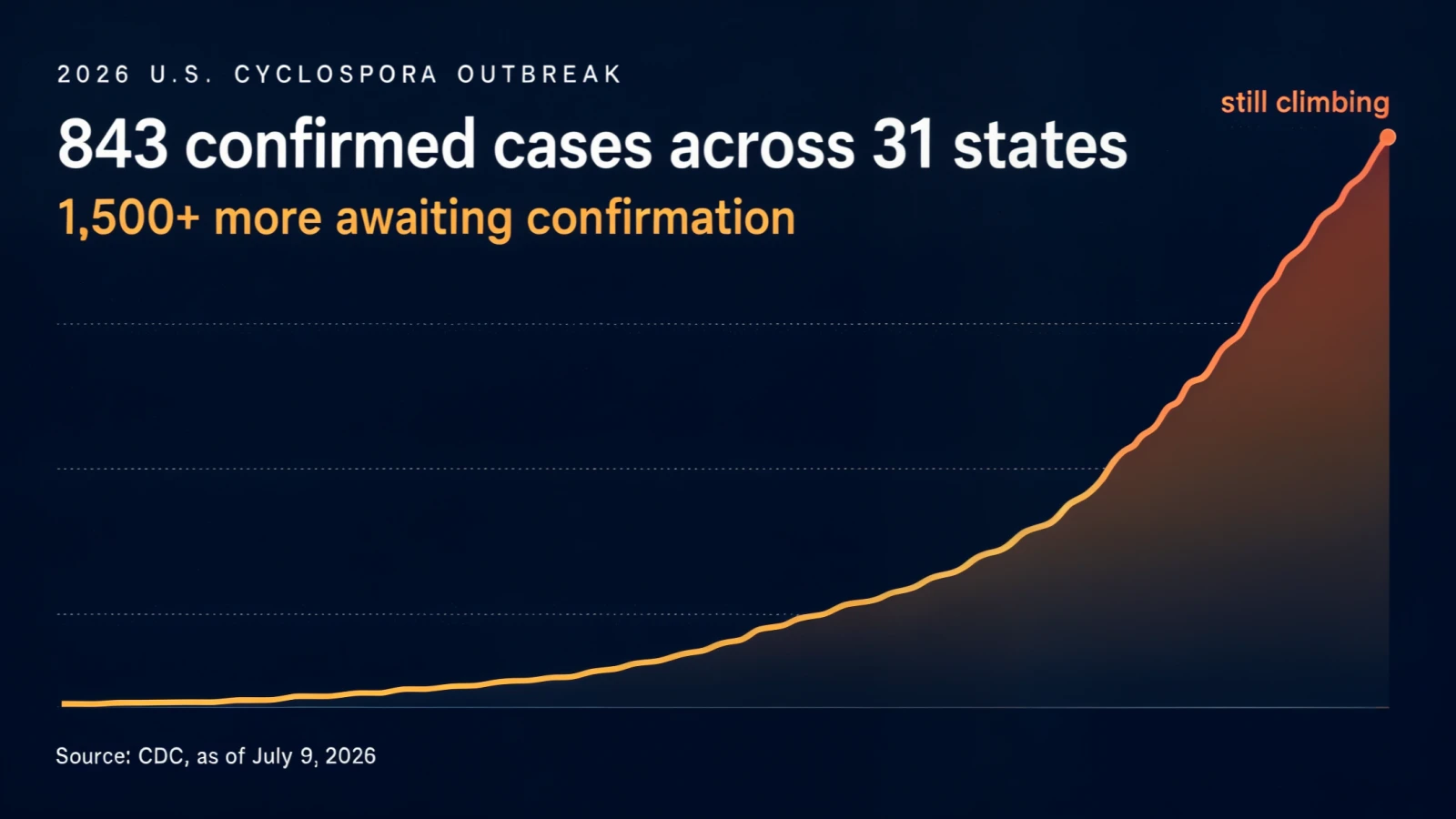
- The CDC reports 843 laboratory-confirmed cases of cyclosporiasis acquired inside the United States across 31 states, with 86 people hospitalized and no deaths, among people who got sick between May 1 and July 5.
- The CDC also says it's aware of more than 1,500 additional cases that still need analysis to confirm, so the confirmed count is a floor, not a ceiling.
- Michigan is the epicenter. Its health department reported more than 2,600 cases by July 13, up from about 170 at the start of the month, in a state that usually logs around 50 in a whole year.
- Ohio is a second hot spot. Its health department confirmed 177 cases by early July, and counties near the Michigan border were tracking several hundred more.
- No food, brand, grower, or restaurant has been officially named, and no recall has been issued.
For the running counts, the affected states, and updates as they come, our 2026 Cyclospora outbreak page tracks the live numbers. What matters is the trend line. This started as a routine CDC advisory of 145 cases in mid-June and became a national story in a matter of weeks.
Is the 2026 Cyclospora outbreak the largest in U.S. history?
This is the question worth answering carefully, because the true answer depends entirely on what you compare it to. Two things are true at once.
Yes, by the numbers, it's shaping up to be the biggest Cyclospora event the United States has recorded. Before this year, the biggest Cyclospora season on record was 2019, when a CDC study counted 2,408 confirmed, domestically acquired cases across the whole season, the most since the illness became nationally trackable in 1999. The largest single outbreak tied to one food was the 2020 bagged-salad outbreak, which the FDA put at 701 illnesses in 14 states. Michigan alone is already reporting more cases than either of those records. That comparison isn't final, because Michigan's total counts probable as well as confirmed cases while those older records are confirmed only, and the national season isn't over. But the direction is clear, and 2026 is on track to be the biggest Cyclospora year the country has seen.
No, it's almost certainly not the largest foodborne outbreak of any kind, and it's not close. That record belongs to a different league of germ. In 1994, contaminated Schwan's ice cream caused a Salmonella outbreak that a New England Journal of Medicine study estimated sickened about 224,000 people nationwide. Cyclospora, a parasite, spreads and scales differently than Salmonella or E. coli bacteria, and its outbreaks have always been counted in the hundreds or low thousands, not the hundreds of thousands.
That raises the real question hiding inside the word "outbreak." Is this one outbreak or several? The CDC is investigating several clusters at once, and it says some of the cases haven't been linked to a common source. Michigan on its own looks like a single linked outbreak, and the state is treating it as one. What nobody's established yet is whether the clusters in different states trace back to the same food. If they do, this becomes one of the largest single Cyclospora outbreaks the country has seen. If they don't, it's a record surge built from several separate ones.
The way the cases are counted is part of why that stays open. The often-cited "2019 outbreak of 2,408 cases" wasn't one outbreak from one food. It was the total for the entire 2019 Cyclospora season, spread across many separate clusters, and only about one in ten of those cases was ever tied to the imported basil that made the news. The 2026 numbers are being tallied the same way, as a season made of several clusters that may or may not share a source.
Why are Michigan's numbers so much bigger than the CDC's?
Because the two agencies count different things, and because Cyclospora is badly undercounted to begin with. This is the most confusing part of the coverage, so it's worth slowing down.
The CDC only counts cases that a laboratory has confirmed and that have been reported up the chain to the federal level, and only after analysts confirm the person didn't pick up the parasite while traveling abroad. States like Michigan report both confirmed and probable cases, and they report them faster, straight from local health departments. The CDC itself assumes roughly a six-week lag between when someone gets sick and when their case reaches the national count, which is why it expects the federal number to keep rising. So Michigan's 2,600-plus and the CDC's 843 aren't a contradiction. Michigan's cases feed into that same national count, just sooner and with a looser bar. You shouldn't add the two together. And the CDC's 843 is a real number, only a narrower and slower one, since it counts just the cases that labs have confirmed and that have cleared the federal review.
Two other things push the true count higher than anything published. Cyclospora isn't part of a routine stool test unless a doctor asks for it by name, and many sick people are never tested at all. Others recover on their own and never see a doctor. That's why the CDC says the real number of people sick is very likely higher than what gets reported. The CDC also made Cyclospora tracking optional in its FoodNet surveillance system in mid-2025, the year before this surge, though that system was never the main way outbreaks get spotted.
What about Taco Bell?
Our firm has heard from many people who got sick this summer soon after eating at Taco Bell, and we already represent a number of them. We're taking on more of these cases and preparing to file the first of them. That's why we're looking hard at Taco Bell. What we're not doing is saying the chain caused the outbreak. No government agency has named Taco Bell, or any other restaurant, grower, or food, as the source, and until investigators do, that question stays open.
What put Taco Bell in the conversation is real and documented. In early July, news outlets including Nation's Restaurant News reported that select Taco Bell locations temporarily pulled lettuce, pico de gallo, guacamole, and a cilantro-onion blend from their menus. Some stores posted signs telling customers the items were unavailable because of a recall, even though no produce recall has actually been announced by any agency, and Taco Bell hasn't publicly explained the change. Those are the same kinds of fresh produce that Michigan health officials have urged extra caution around. That timing is why people are asking, and it's a fair question to ask. But a question is all it is.
If you ate at Taco Bell and a lab later confirmed you had Cyclospora, that overlap in timing is worth documenting, whatever investigators eventually find. Save your receipts, your app or delivery orders, and any photos of your meal. We're looking into Taco Bell along with other restaurants and produce suppliers, and we can help you figure out where your own illness may have come from.
Why is the source still a mystery?
Because Cyclospora is one of the hardest foodborne germs to trace, for reasons built into the parasite. If you want the full picture of what Cyclospora is and how it makes people sick, our explainer on the Cyclospora parasite behind the outbreak covers it. For the source question, four things work against investigators at once.
- You can't fingerprint it easily. For Salmonella or E. coli, labs can match a patient's strain to a specific food lot. Cyclospora can't be grown in a lab the same way, and the CDC says the molecular tools for linking cases are still being developed. Investigators lean on interviews and patterns instead.
- The trail goes cold fast. Symptoms usually start about a week after the contaminated food is eaten, and the illness can relapse for weeks. By the time a test comes back, the food is gone and the receipts and memories have faded.
- It usually starts before the food is packed. Cyclospora typically gets onto produce during growing or harvest, often through contaminated water, well before it's shipped. One bad lot can fan out to many restaurants and stores at once.
- The proof is rarely conclusive even when they get close. In that 2020 bagged-salad outbreak, the FDA traced the salads back to farms and even found Cyclospora in a Florida irrigation canal, and still couldn't confirm a genetic match to the sick people. Sometimes the honest finding is that the trail runs out.
Put those together and you get an outbreak that can grow into the thousands while its source stays officially unknown for weeks or months. That is how hard this particular parasite is to trace.
What to do if you think you got sick
If you have had days or weeks of watery diarrhea this summer, a few steps protect both your health and your options.
- Ask your doctor specifically for a Cyclospora test. It isn't always part of a routine stool workup, so name it, and be ready to give more than one sample on different days, because a single negative doesn't rule it out.
- Report your illness to your local or state health department. This is how investigators connect scattered cases and trace the food behind them, which helps protect other people too.
- Save what shows what you ate and where. Receipts, grocery loyalty or delivery-app records, a photo of the produce or the meal, and any packaging. Note the dates.
- Write down a simple timeline while it's fresh. What you ate in the two weeks before symptoms started, when they started, and what each provider told you.
Because the source of this outbreak hasn't been named, your own records may turn out to be the strongest evidence there is if contaminated food made you sick. If you're wondering whether you have a claim, you can talk with our Cyclospora team at no cost, and if you got sick in the hardest-hit state, here's how food poisoning claims in Michigan work. The consultation is free, so it costs you nothing to learn where you stand.
Frequently asked questions
How many people have gotten sick in the 2026 Cyclospora outbreak?
As of July 9, 2026, the CDC reports 843 laboratory-confirmed cases acquired in the United States across 31 states, with 86 hospitalized and no deaths, plus more than 1,500 additional cases awaiting confirmation. State counts run far higher because states report faster and include probable cases. Michigan alone reported more than 2,600 by July 13.
Is this the largest Cyclospora outbreak in U.S. history?
It's on track to be. Michigan's count alone, which includes probable as well as confirmed cases, has already passed the previous record Cyclospora season of 2,408 confirmed cases in 2019, and the national season isn't over. It's not, however, the largest foodborne outbreak of any kind. Bacterial outbreaks like the 1994 Schwan's ice cream Salmonella outbreak, estimated at about 224,000 cases, were far larger.
Is Taco Bell the source of the outbreak?
No agency has said so. No government agency has named Taco Bell, or any food or restaurant, as the source. Some Taco Bell locations did pull lettuce, pico de gallo, guacamole, and a cilantro-onion blend in early July. Ron Simon & Associates is investigating the chain, already represents a number of people who got sick after eating there, and is preparing to file on their behalf. Even so, the source of this outbreak hasn't been officially identified, and we're not saying Taco Bell caused it.
Why is Michigan's number so much higher than the CDC's?
They count differently. The CDC reports only laboratory-confirmed, U.S.-acquired cases that have reached the federal level, which lags by about six weeks. States like Michigan report confirmed and probable cases much faster. The two figures describe the same national picture, so they shouldn't be added together.
Has there been a recall in the 2026 Cyclospora outbreak?
No. As of mid-July 2026, no federal recall has been issued and no food source has been named. Reports that some Taco Bell locations cited a recall on in-store signs don't match any recall announced by the FDA or CDC.
Can you sue if you got sick in this outbreak?
You may have a claim if a lab confirmed the infection and it can be linked to food you ate, whether from a restaurant or a store. Because the source hasn't been named, keeping your own records matters. Ron Simon & Associates reviews Cyclospora and food poisoning claims at no cost, and you pay nothing unless the firm recovers money for you.
This article is general information, not legal or medical advice. If you have severe or lasting diarrhea, signs of dehydration, or you are worried about someone who is very young, older, or living with a weakened immune system, call your healthcare provider. For official updates on the outbreak, follow the CDC, the FDA, and your state health department.