
What We Know About the Midwest Poultry Services Egg Salmonella Outbreak
CDC and FDA have linked 98 Salmonella Enteritidis illnesses and 26 hospitalizations across 17 states to shell eggs, and 73 of those cases are in Texas. No deaths have been reported. Of the 44 people investigators interviewed, 40 (91 percent) reported eating shell eggs in the week before they got sick. On July 22, 2026, Midwest Poultry Services recalled 1,589,577 dozen eggs, roughly 19 million eggs, produced on its two Texas farms. Both the CDC investigation and the FDA advisory are still open.
The hospitalization rate here is high. Twenty-six of the 72 people whose records CDC has reviewed ended up in the hospital, about 36 percent. Illnesses have been reported in people from under one year old to 81, with a median age of 48.
Where the 98 Illnesses Were Reported
Texas has 73 of the 98 reported illnesses, and the recalled eggs were laid and packed at two Texas farms. FDA confirms recalled-product distribution in Texas, Arkansas, Louisiana, Mississippi, New Mexico, and Oklahoma, but neither FDA nor CDC has said why the Texas case count is so high or described Texas as the largest market. After Texas, Louisiana reported 5 cases, Arizona 4, and Georgia and New Mexico 2 each. Twelve more states reported a single case: California, Colorado, Illinois, Michigan, Missouri, Mississippi, North Carolina, Nevada, New York, Oklahoma, South Carolina and West Virginia.
Ron Simon & Associates is based in Houston, and Texas food poisoning claims are the work our firm does every week. If you got sick in Texas, our Texas food poisoning lawyer page walks through the deadlines and rules that apply here.
What the Egg Recall Covers, and How to Check Your Carton
Three things have to line up, and all three are printed in date-coding ink on the side of the carton, not the top. Turn it sideways to find them.
- Plant code P-1950 or 0840962. FDA’s product table prints that second code without the leading zero, as 840962, so either rendering counts.
- A Julian date between 157 and 184. A Julian date is the numbered day of the year, so 157 is June 6 and 184 is July 3, 2026.
- A sell-by or best-by date between July 20 and August 17, 2026.
Bulk foodservice cases carry the same plant code, and some are also printed Packed by MPS Egg Farms, the name Midwest Poultry Services trades under.
On August 12, 2026, FDA classified both recall records as Class I, the agency’s most serious category, and published that classification in its Enforcement Report on August 19. FDA uses Class I when it finds a reasonable probability that eating the product could cause serious health consequences. That’s the agency’s read on the hazard, not a finding against the company. Both records, H-1229-2026 for the brown cage-free eggs and H-1230-2026 for the white shell eggs, are still listed as ongoing, which means the recall hasn’t been terminated.
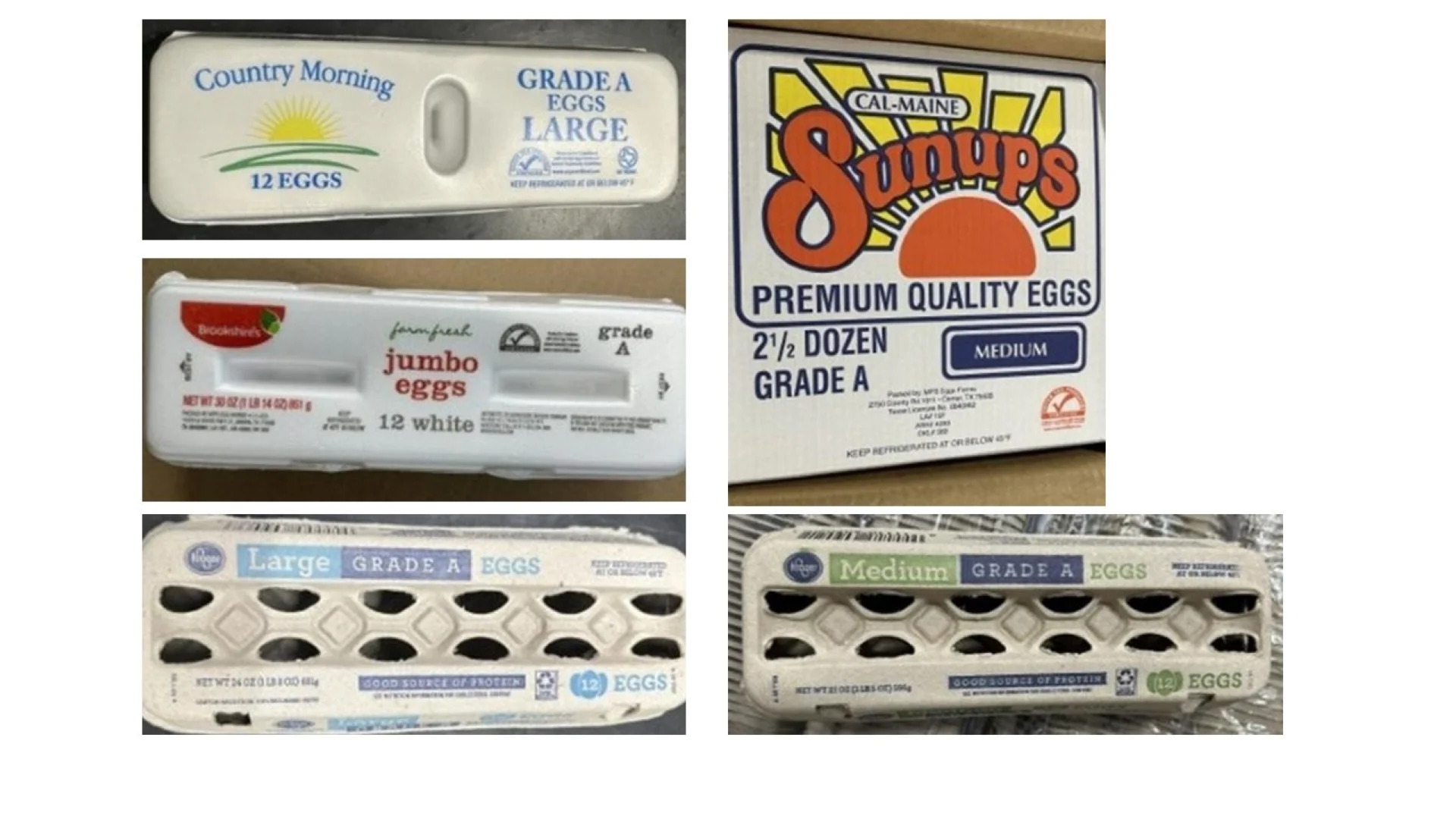
The recall covers white shell eggs and brown cage-free shell eggs sold in bulk and in packs of 6, 12, 18, 24, 30, 36 and 60, under the Kroger, Simple Truth, Brookshire’s, Country Morning and Cal-Maine Sunups labels. They reached Kroger stores in Texas and Louisiana, Brookshire Grocery stores in Texas, Oklahoma, Arkansas and Louisiana, and other smaller retail and foodservice outlets in those states plus Mississippi and New Mexico. If you already tossed the carton and can’t check the code, FDA’s advice is to throw the eggs out rather than guess.
The Recalled Eggs Don’t Explain Every Illness
This part of the investigation matters if you’re deciding whether you have a claim. FDA’s advisory says plainly that Midwest Poultry Services “does not account for all the illnesses in this outbreak,” and that investigators are still working to find other sources.
The calendar shows why. The first illness in this outbreak started on November 21, 2025. The recalled eggs weren’t produced until June 6, 2026. More than six months of cases came before the recalled product existed, so something else was making people sick for at least part of that stretch. FDA calls the recalled eggs “a likely source” and says the outbreak is linked to them “in part.”
For a claim, what matters is whether you ate eggs from the recalled brands and codes inside the recall window. That’s why the carton, the receipt and the lab result matter so much.
CDC Flagged Antibiotic Resistance in This Strain
CDC’s sequencing found that the outbreak strain is predicted to be nonsusceptible to ciprofloxacin and resistant to nalidixic acid. Ciprofloxacin is one of the drugs doctors turn to when a Salmonella infection is severe enough to treat. Nalidixic acid isn’t used to treat Salmonella, but resistance to it is a standard marker that the related drugs may not work. CDC says the strain is related to one found previously in chicken, eggs and backyard poultry.
Most people with Salmonella recover on their own and never need antibiotics. But CDC’s warning is worth repeating to your doctor: when antibiotics are needed, some illnesses in this outbreak “may not be treatable with some commonly recommended antibiotics and may require a different antibiotic choice.” Mentioning the outbreak by name helps your care team pick a drug that works.
What Salmonella Enteritidis Does, and Why Eggs Keep Causing It
Salmonella Enteritidis is the serotype behind most egg outbreaks, and the reason is biology. The bacteria can infect a hen’s reproductive tract and get inside the egg before the shell forms, so the contamination isn’t something washing the outside of the shell can fix. Cooking eggs until the yolk and white are firm kills it. Runny yolks, homemade dressings, soft scrambles and raw batter don’t.
Symptoms usually start 12 to 72 hours after a contaminated meal and last four to seven days: fever, stomach cramps and diarrhea that’s sometimes bloody. A smaller group of people develop reactive arthritis weeks after the stomach illness clears, with joint pain, swelling and eye irritation that can last months. Our reactive arthritis lawyer page explains how those longer cases are handled. For background on the infection itself, see our Salmonella lawyer page.
Your Legal Rights
If recalled Midwest Poultry Services eggs made you sick, you may be entitled to compensation for medical bills, hospital costs, lost income, and the pain and disruption the illness caused. Under product liability law, a company that puts contaminated food into the market can be held responsible for the harm it causes, and in most states you don’t have to prove it was careless. That standard varies by state, so what you have to show depends on where you got sick.
What builds a case is evidence, and it can disappear fast. A stool culture can document a Salmonella Enteritidis infection, and public health laboratories may be able to compare an isolate with the outbreak strain. A receipt, loyalty-card record or delivery-app history helps document the purchase. The carton itself, with the P-1950 or 0840962 code, connects the purchase to the recall. No single record proves the entire claim, and if some of it is already gone, it is still worth asking what can be recovered.
Ron Simon & Associates is a food poisoning law firm that has recovered over $850 million for victims nationwide. Our Salmonella lawyers handle foodborne illness cases and nothing else, and we’re reviewing claims from this outbreak now. You pay our law firm nothing unless we recover money for you. Results vary by case. Call 1-888-335-4901 for a free consultation.
